NorthCape4000: retrofit, crank length & fit — looking after joints on a long route
Tom · 15.04.2026
NorthCape4000 2026 — for me the route from Berlin towards the North Cape — is officially an adventure, not a race (northcape4000.com). I still want day after day to ride efficiently and without unnecessary pain. The bike has to fit me, not the other way round. The setup overview and Bike & cockpit describe the foundation. This piece is what came after: retrofit, crank length, saddle and tools — with one clear health caveat: I am not a doctor or a qualified professional bike fitter; this is my experience and not guidance for everyone.
Starting point: lower position, knee, hip
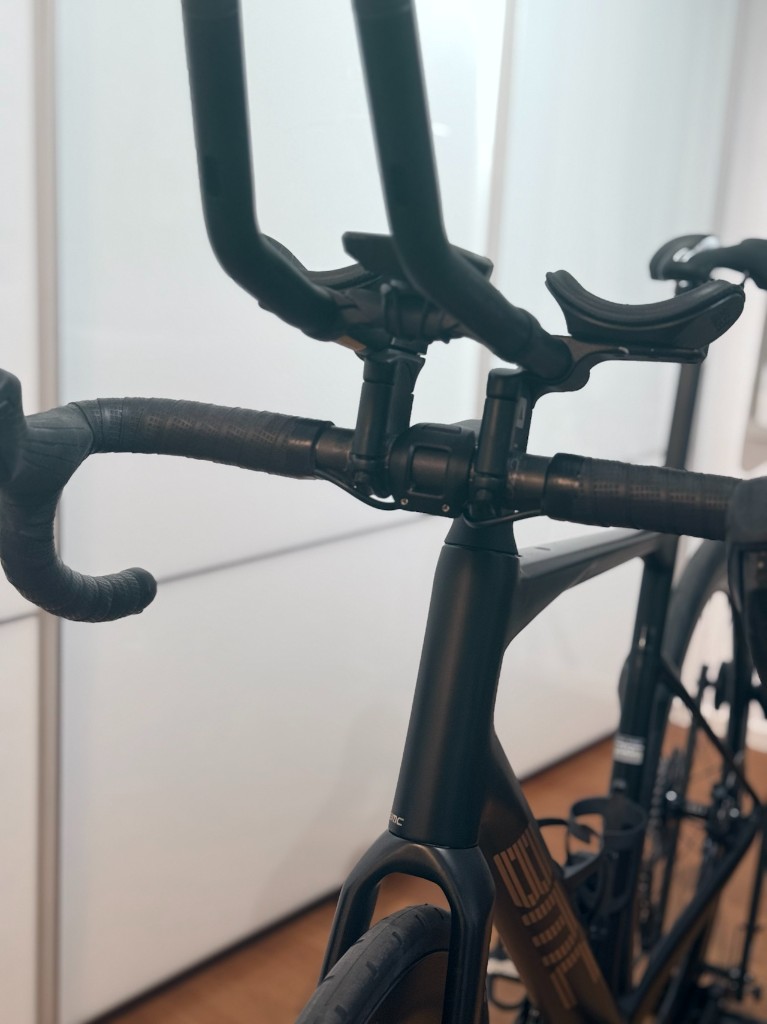
The Roadmachine runs Profile Design triathlon extensions — a big win for me on long rides (context: Bike & cockpit). The position also gets lower and more stretched. That shifts load: on longer sessions on the extensions I felt no sharp pain, but a steady light pressure at the knee — enough to take seriously. At the same time the hip angle in the aero posture was somewhat tighter than on a classic tops position. For an event measured in thousands of kilometres with high cadence repetition, I wanted it sorted — not ridden through.
Anchor: Selle Italia IDmatch
My measurement baseline came from a Selle Italia IDmatch bike fitting — validated, stable for years, nothing I wanted to discard. Still: new cockpit, new goals on the NC4K route ⇒ reworking is fair game. Nerd alert: I also used AI as an experiment sandbox to structure options, cross-check literature and pro context, and sort hypotheses. Decisions landed on the turbo trainer, on the road and from how my body reacted — never from a prompt alone.
One concrete retrofit step: shorter crank
Where I started: crank arms 172.5 mm.
Change: down to 170 mm.
Shorter cranks shift how load sits between hip, knee and saddle contact — on the bike they mean different levers and a different tempo through which the hip tracks over the bottom bracket. That gave me another degree of freedom: I ran the saddle slightly higher — rebalancing via the second main contact point — and then each time checking the whole picture, not a single number in isolation.
Saddle: height and forward steps
Because I moved the saddle forward in small steps at the same time, I did not end up with one new position but a cluster of trial settings: each time short sessions, notes, feel, back to baseline logic: centre of mass, hip and knee stability, no rocking. What helped was distilling almost 30 years of practice alongside every fitting school on my radar — from classics through current pro sport to what I could sensibly take for me from screens and paper.
Video: making stability visible
From feel alone I would have struggled to judge hip and knee stability consistently. Front-view video with a simple check protocol showed me where I wander, where the line stacks, and where I needed fine-tuning at the foot–cleat interface or pedal alignment — one parameter at a time, never five at once.
What I noticed (subjective)
Interestingly, with the current setup my maximum reachable cadence — without bouncing on the saddle — went up by about 15 rpm. And: the knee pressure is gone. That is not a universal rule (your body, your clinician, your anatomy), but for me it is proof the effort paid off.
MyVelofit, AI — and why no tool decides alone
I brought MyVelofit into the mix too. I found it useful with prior knowledge: if you do not know what sits behind the model, numbers read like truth too quickly. Always: listen to the real body — pain, fatigue, asymmetric patterns, sleep, training dose. No tool may decide alone; at best suggest, then verify on the road.
Takeaway
Quite a bit of effort — but worth it for me. You can equally get this done via a professional bike fitting — without the DIY route. I’m too into this topic not to combine recent methods and tech deliberately with hands-on work.
For my NorthCape4000 bike that closes the thread on retrofit and material / positioning know-how for this chapter — for now.
Series: Preparation overview · Bike & cockpit · My NC4K setup